Posts

Showing posts with the label sanseiru

"Forgotten" techniques #2: sokumen awase
Image
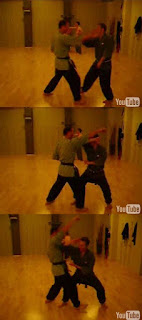
Sokumen awase uke An excellent technique that I feel has "slipped under the radar" is that which I call "sokumen awase uke" (side of the head "matching" block). 1 A video showing the inside and outside sokumen awase uke What is sokumen awase uke? 2 There are 2 kinds: both utilise similar body mechanics, but result in a different deflection. Inside sokumen awase uke The first of these is the inside sokumen awase uke. It is performed by using your palm and forearm to catch an incoming punch, the guide it past your head as you move on the inside of your opponent. The "matching" occurs insofar as you go out to meet the attack, match its speed and redirect it past. The pictures to the right illustrate this technique. This inside sokumen awase uke occurs, I believe, in the kata sanseiru. However in most schools this technique now appears as a "jodan uke" (ie. an age uke or rising block). Consider for example the photograph on the left...

Is mawashi uke goju's rising block?

Image
Like most other karateka, practitioners of goju ryu faithfully practise the standard age uke (rising block) during basics training. They will apply it in ippon kumite (one-step sparring), "find" it in kata bunkai (application analysis) and desperately try to apply it in sparring. But is it really a goju technique? What karateka call "age uke" is really a basic shorin technique. The only kata in which it is found are the 2 gekisai forms, developed and introduced by Miyagi in the early 1940s as basic kata for school children. Prior to that one wonders whether it was even practised in goju dojos... This question has lately led me on a journey to discover whether goju ryu has its "own" rising block. What did goju/naha te practitioners use for defences to head height attacks before age uke was incorporated into the syllabus? As summarised in the video below, I feel that the answer is to be found in goju's famous "mawashi uke" or roundhouse bl...

Asymmetry in sanseiru

Image
Introduction Readers of my blog will be familiar with my previous discussion concerning what have become known as cluster “H” and cluster “M” goju-ryu kata (see my article The origins of goju-ryu kata: Part 1 ). Cluster “H” consists of Higaonna Kanryo sanchin, sanseiru, seisan and suparinpei. Cluster “M” consists of the remainder. Katas in both clusters follow a general design pattern as follows: A — an opening sequence B — the body of the kata, often capable of being broken up into smaller groupings, eg. B1, B2, B3 etc. C — a closing sequence. What differentiates the clusters in design terms is the portion I have labelled “B”: In cluster “H” this portion is largely asymmetrical (ie. right side biased). In cluster “M” this portion — and more specifically each sub-portion (eg. B1, B2, B3 etc.) is symmetrical (i.e. techniques — including turns — are performed more or less equally on both right and left sides). The particular asymmetry of sanseiru In no kata is the asymmetry of cluster ...

Reversing kata movements in application

Image
There are one or 2 moves in goju kata where I “reverse” the direction of stepping/movement while performing bunkai (applications). I’ve often wondered whether — (1) the kata were deliberately designed that way “as a code” (something I think is a bit overstated nowadays); or (2) the kata were deliberately designed that way for an application I haven’t seen; or (3) the kata were deliberately designed that way for training or symbolic purposes (eg. stepping forward on the last move in gekisai dai ichi — said to reflect the “boldness” of the kata), not for any particular bunkai; or (4) the kata have been wrongly passed down in respect of a particular move. Consider the following move from sanseru kata at about 7:38 in the following video of Higaonna Morio sensei. In most kaiha it is performed as a leg catch with a step back — see the following video at about 0:48: (note however that I would personally prefer a leg catch on the other side, but the move is the same in principle). Over the y...

Sanseiru kata and its variations: Part 2

Image
[Note that this is a continuation of Part 1 of this article.] One of the chief differences that has been pointed out to me about the way I was taught to do sanseiru and most other dojo is that in the second shiko dachi a jodan uke / age uke is used instead of the sokumen awase uke . In this variation (as demonstrated by Teruo Chinen and perhaps the most common and regarded as the standard) the feet in the shiko are angled 90 degrees but the body is turned 45 degrees. The kata performer then effects a jodan/age uke (not an inside sokumen awase uke as I had always assumed - it looks like it could be one). The problem I have with this is set out below: The bunkai doesn't seem to me to have the feet at 90 degrees, and for good reason: the angle of your forearm would simply be insufficient to create a deflection. See this video for an example: You'll note at at about point 1.33 that the angle of the defender's feet is about 45 degrees and the body is then further turned so tha...

Sanseiru kata and its variations: Part 1

Sanseiru/sanseru is an interesting kata in historical terms. Not only is it practised by all goju-ryu schools and tou'on-ryu, but also by uechi-ryu. Yet it is a kata that has arguably the greatest variation from school to school. The uechi-ryu version appears completely unrelated to the goju/tou'on versions. The tou'on-ryu version is very different from its goju cousin at the beginning (no mae geris) and does not end with the double ko uke. There is also no kansetsu geri, but rather a stomping ball of the foot to the hip joint. Some suggest that this is because Chojun Miyagi learned the kata off someone other than Kanryo Higaonna - he was away doing military service when Juhatsu Kyoda and others learned it. Seiko Higa's version is subtly different, although I'm not sure exactly how - more on that later. I know that our version (brought back from Okinawa in the 60s) looks a little different from most goju kaiha in 2 respects: 1. The "mae/rising empi" perfor...