Posts

Back to basics: front kick

Image
Introduction: the basic front kick Following my recent "back to basics" theme and my article " Enter the front snap kick ", I thought I'd discuss how to go about doing a basic front kick. Apart from discussing the basic form and some of the finer points (eg. hip use), I thought I'd also go into the differences between (and the relevant uses of) the front ball of foot kick vs. the heel kick. Step 1 Start by raising one knee (in this case the right) with your knee fully bent and the underside of your foot parallel to the ground. The most common mistake at this point is where the underside of the foot is not parallel to the ground; instead the ankle is pointing downwards. The consequence of this is that your kick effects a scooping action which can damage your toes and is generally ineffective. Make sure that you maintain your guard - ie. you should keep your arms up in a defensive posture. You should maintain the same guard throughout the kick. Step 2 Sna...

Bridging the gap between karate and the internal arts: Part 1

Image
Introduction Many karateka I know have a lingering fascination with Chinese martial arts (even if they sometimes don’t or won’t acknowledge it publicly). That is to say, they want to know more about the Chinese arts to see whether this knowledge will enrich their understanding of karate. After all, karate is said to be a descendant of the Chinese martial arts: even its name “karate” is a reference to its mainland origins. The original characters for karate were 唐手, which literally translates as “hand(s) of Tang”. The character for “Tang” (唐) was a reference to the Tang dynasty and became widely used to refer to China. In other words, karate originally meant “Chinese hand”. It was only in around 1932 that a decision was made, due to political pressure arising out of the prevailing nationalism, to change the characters to “空手”, a homonym which means “empty hand”. I have dealt with the connection between karate and the Chinese martial arts in various articles (for example, see ...

“Check your brain in here”

Image
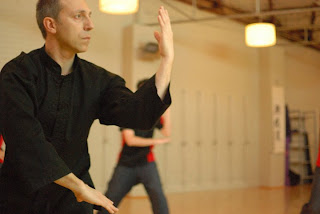
Occasionally folks who come to try out my taijiquan (t'ai chi ch'uan) class will "turn up their noses". "It's too complicated," they say in an accusing manner, as if I've deliberately tried to make them look stupid by giving them an impossible task or required an "anal" level of detail. They want to "flow" or "move their spirit" or "be one with their mind and body" or some other vague new-age concept. They identify taijiquan with such concepts and they expect to be "naturally good at it". Experts even. All without having tried it before. After all, they might have gone to some qi gong (breathing exercise) classes, meditation courses or something similar, where all they had to do was sit or stand, “breathe”, chant mantras and maybe do some basic macro body movements like swing their arms loosely. And that was all "natural". Or maybe they went to a yoga class where their genetic flexibilit...

Internal arts fact and fallacy: double weighting

Image
Introduction There is a classic principle in the internal arts (specifically taijiquan) commonly referred to as “the rule against double weighting”. To me, this is one of the most misunderstood principles associated with the internal arts. Many proponents of this principle will insist that the body should never “double-weighted”. In other words, weight is always biased on one leg or the other, not distributed equally over both. A drill I teach beginners who are learning the Chen Pan Ling "99" taijiquan form The fallacy: your body inevitably passes through double-weighted points! In literal terms the “rule against double weighting” is clearly a fallacy. Consider for a moment that you will, sooner or later, have to transfer your body weight from one leg to another. And as you do so your body will have to pass through a point where your weight is, however transiently, evenly distributed over both legs. In Chen Pan Ling taijiquan we acknowledge this ...

Why blocks are not “strikes in disguise”

Image
Introduction There is a sentiment that I’ve often come across in the martial arts to the effect that “all blocks are actually strikes”. If they aren’t strikes, then they are “locks, holds, throws” – in fact anything other than “blocks”. To my mind this is a modern slant brought about by a misunderstanding of how “blocks” actually work. In this article I propose to explain exactly why traditional blocks are actually (mostly) deflections . To the extent that they can be used for other purposes (in particular, strikes), these are secondary, and to interpret them otherwise is to miss out on a vast and important part of the traditional fighting arts arsenal. Blocks can be strikes – but that doesn’t mean they always are First, I need to get this out of the way. Yes, you can employ blocks as strikes. There are many situations where I would do so, and I support the general notion of “inclusive” bunkai (kata application) analysis. But there is a modern trend that goes much furt...