Posts

Showing posts with the label stances

The importance of basics
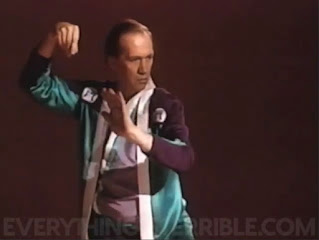
Image
Over the years, I have often written about basics but I don't think I've ever talked about them more broadly - in particular about their importance. Recently I have been watching excerpts of David Carradine in the television series "Kung Fu" (my YouTube feed has assumed I'm a huge fan and this is inevitably reinforced every time I watch another video). One thing I notice is just how bad Carradine's technique is. It's downright awful. In a way, it reminds me of young Ralph Macchio in The Karate Kid: as the movie series progressed I kept expecting him to get better. I thought: "Surely he's been training in the meantime?" Only he didn't get better. Ditto Carradine. With the latter in mind, rather than show you a bit of the series, I thought it would be more illustrative to show you David Carradine demonstrating martial arts  after  he finished the series and had (apparently) undergone much, much more training. It's hard to explain exact...

Back to basics: stances

Image
Introduction Some time ago I wrote the article " The role of traditional stances ", however I have never attempted to describe these in any real detail (although I have previously discussed stances and stepping in stances in various articles, eg. " Northern and southern kung fu, karate and the question of range "). So following my last post about basic blocks, I thought I'd describe how to assume the basic stances of karate (and most other traditional martial arts): Heisoku dachi (attention stance) Feet together, weight evenly distributed. Musubi dachi (V stance) Heels together, feet out at angles, weight evenly distributed. Heiko dachi (parallel stance) Feet parallel, shoulder width, weight evenly distributed. Hachiji dachi (figure 8 stance) Feet angled outwards, shoulder width, weight evenly distributed. Zenkutsu dachi / gong bu (forward stance) Feet shoulder width, weight 70% on front foot, 30% on back, front shin vertical, outside edge of front foot pointi...