Posts

Showing posts with the label neko ashi

Back to basics: stances

Image
Introduction Some time ago I wrote the article " The role of traditional stances ", however I have never attempted to describe these in any real detail (although I have previously discussed stances and stepping in stances in various articles, eg. " Northern and southern kung fu, karate and the question of range "). So following my last post about basic blocks, I thought I'd describe how to assume the basic stances of karate (and most other traditional martial arts): Heisoku dachi (attention stance) Feet together, weight evenly distributed. Musubi dachi (V stance) Heels together, feet out at angles, weight evenly distributed. Heiko dachi (parallel stance) Feet parallel, shoulder width, weight evenly distributed. Hachiji dachi (figure 8 stance) Feet angled outwards, shoulder width, weight evenly distributed. Zenkutsu dachi / gong bu (forward stance) Feet shoulder width, weight 70% on front foot, 30% on back, front shin vertical, outside edge of front foot pointi...
The enigma of tiger mouth in cat stance

Image
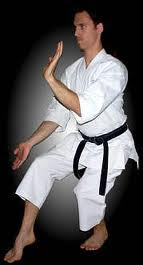
In my article " Xingyi stepping vs. karate stepping " I noted that "after 3 years of blogging I still keep coming across martial principles/methods that I take as self-evident, but of which others might not even be aware". While I'm on this topic, and while I'm on the topic of lessons learned from studying the internal arts (see " You know too many forms "), I thought I'd deal with another topic that I have, for many years, taken as a given - namely the answer to the "engima of tiger mouth in cat stance". You might well ask: "What is this enigma?" I'll start by explaining that the tiger mouth (tora guchi) is a commonly used technique in Okinawan kata, particularly in the Naha te systems. It usually comes at the end of a mawashi uke (roundhouse block). Sometimes the technique is executed in a sanchin dachi ("sanzhan" in Chinese systems). But more often than not, it occurs in a neko ashi dachi (cat stance). ...

The role of traditional stances

Image
It has occurred to me that I have not ever addressed one of the major elements of traditional fighting arts before: stances. Stances are an integral part of traditional eastern fighting arts. Moreover they are surprisingly consistent in form. For example, virtually every eastern fighting art has the “forward” stance (sometimes called the "bow and arrow stance"). In Japanese it is called “zenkutsu dachi”. In Chinese it is called “gong bu” (work step). This stance is the “workhorse” of most martial systems. Typically it is shoulder width between the feet but 2 shoulder widths in length with the front knee bent so that the shin is vertical while the back leg is straight. The hips are usually oriented forwards (hence the term “forward stance”). It even exists in yoga where it takes the form of the “warrior pose” indicating its martial links. Another ubiquitous stance is “horse stance”, which is typically bow-legged with the feet 1 ½ to 2 shoulder widths apart, toes either ...