Posts

Showing posts with the label muidokan

Promotional video for Essential Jo

Image
I've prepared this short sampler video for promoting my new text "Essential Jo". Please share. Copyright © 2015 Dejan Djurdjevic

Extract #1 from "Essential Jo"

Image
Here is the first of a series of extracts taken from my upcoming book "Essential Jo: Comprehensive techniques and combat 2 person drills for the Japanese 4 foot staff". The muido/wu-wei dao jo method We call our school “muidokan” or “wu-wei dao guan” – the “house of the way of least resistance”. This reflects both our philosophical and technical emphasis of avoiding unnecessary action by “going with the flow” and using the attacker’s force against him or her. At the core of our jo method are a series of 20 basic techniques called “suburi”. We have retained these from aikijo (the jo method of the art of aikido) as we find them to be a comprehensive catalogue of the different deflections, strikes and sweeps that one can make using the jo. A detailed performance of the first 5 suburi or basic jo techniques Added to this are 9 “kumijo” (literally “an encounter with jos”) – 2 person combat drills that apply the suburi in a dynamic, effective environment. These drills are modele...

Jo: an introduction to the 4ft staff

Image
I will admit to having a love affair that started after I met my wife and that endures to the present day. No, the object of this affection is not another woman/man (although I suspect that my wife, like many women, probably envies its figure!). The object is none other than a 4 foot stick, made of Japanese oak. It feels surprisingly light in the hands, is textured with the bumps and bruises of contact over 20-something years, is well-worn at the edges and smells faintly of my sweat, absorbed over countless training sessions. Like any relationship, my affair with the jo has followed a kind of cycle: a mad infatuation with something brand new, sleek and good looking; periods of frustration and hard work; and more recently a period of renewed appreciation - of loyalty, fidelity, deeper understanding and a kind of reverence. A video where I discuss the basic grips and stance relating to the jo. In short, my old jo occupies a sacred place in my heart. Nowadays I reserve it for solo prac...

"Forgotten" techniques #2: sokumen awase

Image
Sokumen awase uke An excellent technique that I feel has "slipped under the radar" is that which I call "sokumen awase uke" (side of the head "matching" block). 1 A video showing the inside and outside sokumen awase uke What is sokumen awase uke? 2 There are 2 kinds: both utilise similar body mechanics, but result in a different deflection. Inside sokumen awase uke The first of these is the inside sokumen awase uke. It is performed by using your palm and forearm to catch an incoming punch, the guide it past your head as you move on the inside of your opponent. The "matching" occurs insofar as you go out to meet the attack, match its speed and redirect it past. The pictures to the right illustrate this technique. This inside sokumen awase uke occurs, I believe, in the kata sanseiru. However in most schools this technique now appears as a "jodan uke" (ie. an age uke or rising block). Consider for example the photograph on the left...

Keeping grapplers at bay

Image
Brazilian jujutsu practitioners are fond of saying that most fights go to the ground, but as Chad Merriman (also a strong Judo player) likes to say, that's because most people don't know how to stop them from going to the ground. It is important to note that I think one should learn grappling skills regardless of one’s “stand-up” fighting ability. But there have been times where I have not wanted to go to ground for the simple reason that I know my opponent is better there. I have managed to stay on my feet quite successfully despite repeated attempts at "taking me down". How? The answer, I’ve found, is to get used to the "melee" range as I have discussed previously. Invariably the next question I’m asked is: “How do you keep someone at this range?” Yet this misconceives my point: While some schools teach specific “formulae” for keeping grapplers at bay, I’m afraid I can’t offer anything like this. For me the question: “How do you keep a grappler at ...

Staying in the "melee"

Image
My article “ The melee: karate’s fighting range ” has elicited many responses since I posted it on the net – many favourable and encouraging, others not so. I have had cause to address some of the points raised in forums and on the net, so I thought I’d summarise those comments here: But your approach is too risky! One of the principal arguments I’ve encountered is that “giving opponent an opportunity to hit you doesn't make much sense”. Another way this has been put is: “standing toe to toe and attacking will leave you open to attack.” Superficially this argument might seem persuasive. However it relies on several flawed assumptions as to what I meant in my article about fighting in the “melee range” and about self-defence in general. As a starting point, it is worth noting my opinion that the melee is the fight . Everything else is “sport”. Fights aren't about squaring off in stances, donning pads and bouncing etc. The fight will begin and end in the melee. With that in ...

Is karate a "striking" art?

Image
My brother is fond of saying that karate is a "counterstriking" art. However I know that he really means a “countering” art, since karate counters are by no means confined to "striking". Rather, he uses “striking” (and more specifically “counterstriking”) in order to distinguish karate from those arts which are predominantly about grappling. Put another way, the reference to “striking” is not intended to imply any exclusivity in terms of striking (as opposed to locking/taking down etc.) in a counter. Indeed it is a critical mistake to label (or apply) karate as just a “striking” art since it misapprehends karate’s function.... Examples of true “striking” arts are boxing, Muay Thai and savate. Each of these is almost exclusively about landing blows. While I can see why the uninitiated might see karate in the same light, the way in which karate techniques were intended to operate is fundamentally different. Karate (not just goju/Naha-te, but shorin-based systems...

Two for the price of one: more about karate "blocks"

Image
Those of you who have read my article on Why blocks DO work will recall that I mentioned there that every basic block in karate contains 2 movements - the primary block (a larger movement) and a secondary block (a smaller movement) in the "pullback" arm (what some people call the "crossing hand"). I am astounded as to how few karateka today are actually aware of this fact. So what is the function of these 2 movements? Well first, the secondary movement can operate as a deflection entirely on its own. While the move is generally smaller and weaker than the primary movement it can often intercept the attack sooner. And executed correctly it can be just as effective. Consider the pictures to the left of the secondary movement in goju-ryu's chudan uke (chest-level block). Just as the primary movement comprises a circular deflection, so the secondary movement also deflects with a circle (albeit smaller) on the same angle. While the secondary part of the chudan ...

The "melee": karate's fighting range

Image
In my articles “ Evasion vs. blocking with evasion ” and “ The karate 'kamae' or guard ” I have mentioned what I call the “melee range”. This is the range you're in when you're both swapping blows furiously - half a step in to elbows and knees, half a step out to a fully extended kick. In other words, wherever you step, you face a blow. Most other martial artists I know feel very uncomfortable at this range: for them it feels like the “no-man’s land” in tennis – the mid-court where the ball bounces. In other words, it is a place where you might venture on occasion, but generally it is too “hectic” to stay in (at least successfully) for any extended period. Like tennis players, most martial artists nowadays seem to stay at either an extended range (cf. the baseline) or in close at the clinch/grappling (cf. the net). The in-between is avoided, except in transit or unless the chaos of a particular exchange finds you there temporarily. It is no surprise then that this “...

Punching: alignment with the forearm

Image
I have often been asked: "What is the correct alignment of your forearm to your fist in a standard punch?" Given that in karate and most Eastern martial arts (excluding arts such as Wing Chun) the standard punch strikes with the 2 big knuckles, you could be forgiven for thinking that the top of the forearm should align (be flush) with those 2 knuckles. Makes sense doesn't it? But actually this is not the case. Indeed, if you make a fist and then hold your forearm vertically, side on (so that your fist is pointing up and you're looking at your wrist so that you can see whether it angles the fist up or down), you'll notice that you could, if you wanted, make the back of your hand flush with your forearm. That means that the top knuckles are in a straight line with your forearm and your energy is going to be transmitted in a straight line (theoretically). The problem however is that if you look at the palm side of your fist, it now slopes down quite a lot - i...

Muidokan embu: 2-person forms for karate

Image
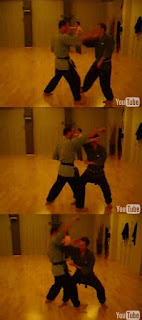
Introduction The concept of 2-person forms as an adjunct to training is not new: in China many schools develop such forms as an additional means of practising their techniques in a contextual environment and packaging their knowledge . In China these types of forms or drills are known as " dui da quan". This tradition is, by contrast, not well established in karate. In order to find 2-person forms in Japan you have to delve further afield into arts such as Doshin So’s Shoriji Kempo or to the Japanese weapons arts such as Tenshin Shoden Katori Shinto Ryu (both of which use 2-person forms as their primary practice method). [Note that Shorinji Kempo call their more sophisticated 2-person forms “embu” (meaning “demonstration”) and, for want of a better word, I have appropriated this word to describe 2-person forms generally.] Ippon kumite vs. embu practice The deficiencies in the standard method of practising kata bunkai (or any other specific technique(s)) in karate has been not...