Posts

Showing posts with the label Visible force

Enter the snap roundhouse kick

Image
In my recent article " The roundhouse kick and traditional martial arts " I wrote the following: "So how does an art like karate treat the mawashi geri? What does it do to make the movement less "risky" and more "applicable" in civilian defence?  It makes the movement less of a "power" movement and more a conservative one. It throws the kick as a snap ." In the early days of debating with combat sports fans I lost count of the number of times that I heard this argument: "If it worked so well, why don't we see it in MMA?" Well, as with the front snap kick , I knew it was only ever going to be a matter of time.  And now, in the space of one week, we've had two separate knockouts , both with the trademark karate mawashi geri keage (roundhouse kick using a snap).  The only difference between these and the kick usually taught in karate dojos is that the instep was used instead of the ball of foot (but then again, t...

The importance of flow

Image
Lessons from China After my recent intensive training with Master Chen, a fellow karateka asked me the following: ”I hope this isn’t a stupid question, but did you learn anything of relevance to karate?” My answer was, “yes”. There were many applications of forms and other techniques which I couldn’t help notice existed in precisely the same form in Okinawan karate. But more relevantly, this trip has reaffirmed one of my core beliefs about the relationship between karate and Chinese martial arts – in particular the internal or “soft” arts: they are really part of the same continuum. What differentiates them on a surface level evaporates once one starts to use biomechanically sound and efficient principles of movement (see my article “ Goju as an internal art ”). One of the most important of these principles is the need for “flow” or connectivity between techniques. Many Chinese martial artists lament that karate seems to have lost any semblance of "flow". While ...

Internal arts and pushing

Image
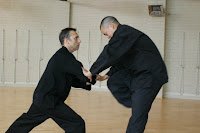
I have previously highlighted my disdain for "mystical" interpretations of the internal martial arts. In my view all martial arts function within the bounds of known physics; there is simply nothing metaphysical - nothing that is left wanting for a "paranormal" explanation. However there are still many people out there who adhere to the opposite view. To quote a correspondent on an internet forum: "My view of internal martial arts is when the strike's power is so refined and seemingly defies physical laws. Where there is a transfer of energy enough to lift someone off their feet yet have very little to no body momentum to justify the result of the strike." And there's the rub: "lifting someone off their feet"... What I want to know is, why do so many people who see themselves as "internal artists" think that pushing is a good measure of martial skill - or applied force, for that matter? Typically, these internal artists will ...

Going solo?

Image
A common criticism of traditional eastern fighting arts is the emphasis those arts place on solo practice - often at the expense of 2 person practise. Indeed, many traditional fighting arts are so steeped in solo forms that they have barely no partner application at all. When they do, it is often stilted, stylised and unrealistic. This criticism has led many martial artists who are interested in pragmatism to abandon solo forms - be they full kata/xing/patterns or shorter drills such as "deflect/strike" combinations - in favour of going straight into 2 person application. I can see the issues - however I still think that, depending on the technique being taught, some level of "solo" training is essential if you want to hone correct, efficient form. In my experience, the need for any "delay" in moving to 2 person drills is a function of just how sophisticated (ie. complex, but for the purposes of gaining greater efficiency) the movement is that you want to...

Visible force vs. applied force

Image
A correspondent recently wrote to me asking about our martial art. He made the comment that “It seems great but a bit lacking in power.” I told him that if by that he meant visible force — yes, he was right. However “visible force” and “applied force” are 2 different things. Some techniques don't look "powerful" because they have a lot less "push". [For a detailed explanation of "force", "power" and the role these play in "hitting hard" rather than "pushing" see my article " Hitting harder: physics made easy ".] The front kick is a case in point. If you do it against a heavy bag you'll be tempted to hit it with more push so as to "feel powerful". On the other hand, when you kick a kickshield you can give it a resounding "crack" that your partner feels right through the shield but which doesn't move him or her more than a foot or 2. As a rule, we don't let students kick or punch th...