Posts

Showing posts with the label combinations

Kata-based defences against combinations

Image
Over the last 2 decades I've noticed an explosion of interest in karate in "bunkai" - applications of karate's kata (forms).  There was a time (in the not too distant past) where karate had stagnated badly.  Kata were practised almost in a vacuum: forms as a series of movements and no analysis on one hand - sparring or two person drills with no nexus to the kata on the other.  This seemed to be the case since karate became popularised in Japan in the 1930s and was diluted for teaching to school kids.  It only got worse in the 1950s and 60s when it spread to the West. By the 1980s I noticed a few teachers trying to claw the way back to bunkai as the primary source of karate knowledge.  As just one example, Higaonna Morio sensei of goju ryu released his 8mm and later video tapes of kata and applications.  Meanwhile, other teachers, like Hirokazu Kanazawa sensei of SKI shotokan, handled the dilemma in a totally different way, cataloging hundreds of two ...
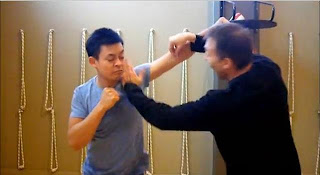
Single whip: Part 2 - general applications

Image
Introduction: the "real world" vs. "attack of the zombies" In Part 1 of this article I dealt with only one defence: against the "sucker punch". I am unapologetic about this: learning how to survive that first "surprise" punch should be a priority in martial arts instruction. Instead it isn't. It is usually buried in a mountain of combinations against " zombie attacks ". You know the kind: slow movement, arms outstretched, no response to your own counters, etc. – countered by a series of wishful strikes that pay lip-service to predictability and that give "overkill" a new meaning. In this article I propose to deal with other, more sophisticated, applications of single whip. And there are many more than those I propose to cover in this article. My goal here is simply to illustrate the general relevance of the sequence: how its movements are congruent with efficient biomechanics in response to common attacks; ho...

"String theory": combinations and their effectiveness

Image
Introduction In my previous posts I have dwelled principally on deflection , evasion and generally on responding to threats. However traditional martial arts techniques aren't always responsive. Often they are proactive. In many martial schools this manifests in very fast combinations; attacks that are strung together in an impressive manner. Indeed, such "strings" are the mainstay of many traditional martial arts. The approach is to continue pressing an attack with such speed and ferocity that you overwhelm your opponent. In this respect I am reminded of a school here in Perth which used to advertise such a methodology on television with the slogan "Fight to the total destruction of your enemy"! Southern Chinese systems (in particular the Hakka school) place more emphasis on such a methodology (eg. the chain punching of Wing Chun and the fast hand exchanges of southern preying mantis). The fact that goju ryu karate also features such "strings...