Posts

Showing posts with the label forearm

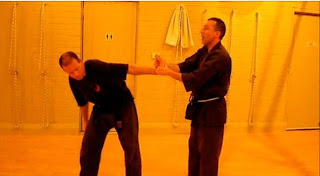
The truth about palm blocks

Image
As readers may or may not know, I've been engaged in a number of large projects this year, both martial and non-martial.  I'll detail these another time. For now, I'll restart my blogging here with "micro posts", featuring mostly videos and brief commentary.  In that spirit, here is the first of my entries on the subject of "palm blocks". It is important to note that the palm can be used to "block" an attack at its source (eg. by jamming the shoulder or hip or other part of the "core") but I haven't gone into this in the above video which is simply taken from class. For more on the topic of forearm vs palm blocks see:  "Why block with the forearm rather than the palm" . Copyright © 2014 Dejan Djurdjevic
Elbow locks: an introduction

Image
Introduction In writing my preceding article " The ikkyo projection ", I became aware of need to address the (rather basic) question: "How should one go about locking an opponent's elbow"? Elbow locks are among the most common techniques in grappling - both in standup and ground fighting. Please note that in this article I'll be covering the type of elbow lock is commonly known as an "arm bar" - ie. a simple hyperextension of the elbow. I'll cover more elaborate twists of the elbow, eg. the "kimura" or "figure 4", another time. Furthermore, in this article I don't propose to analyse ground fighting, at least to any great extent. My primary purpose here is to write an adjunct to my previous article which relates to controlling your opponent's elbow in standup fighting. However I think it goes without saying that the basic principles I cover here are equally applicable both in standup and ground fighting. S...

Why block with the forearm (rather than the palm)?

Image
Introduction One of the most common queries I've had over the years from combat sports practitioners and eclectic martial artists is why traditional martial arts use the forearm as a blocking/deflecting surface. Why not use the palm? Indeed the palm is a useful tool in "blocking" (ie. deflection/parrying and sometimes even actual blocking/stopping). However what is inherent in the question is the assumption that the palm is fundamentally more useful than the forearm. The forearm is often seen as "brutish" or inelegant compared with the sensitivity afforded by the palm. Yet the traditional martial arts are full of forearm blocks. They are common throughout the Asian martial systems. They are even a well-established part of Western boxing traditions, going back as far as Ancient Greece right up to the more modern bareknuckle boxing era. [Consider the adjacent image as one of many examples one can find. As a side note, take a look at hip chamber being used!]...

Variations in ude tanren - forearm conditioning

Image
For most of my martial arts career I have known (and practised, on and off) the orthodox kote kitae or "ude tanren" - forearm conditioning. An example can be found here and below: Master Higaonna Morio and Sensei Falcone practising orthodox kote kitae A variant on the theme can be found here . Without wishing to go into the merits or necessity of forearm conditioning to any great extent in this article, I would like to point out that I feel some conditioning is essential for karate blocks. While I admire the conditioning of many of my goju colleagues, I prefer a slightly "softer" approach which I feel is consistent with my approach to "blocking" generally. Accordingly I have always wanted to combine ude tanren with movements that: (a) apply the same movement that karate blocks apply (which to my mind is more of a deflection than a hard "blocking" movement (see my article " Why blocks DO work "); and (b) actually condition the arm wi...

Punching: alignment with the forearm

Image
I have often been asked: "What is the correct alignment of your forearm to your fist in a standard punch?" Given that in karate and most Eastern martial arts (excluding arts such as Wing Chun) the standard punch strikes with the 2 big knuckles, you could be forgiven for thinking that the top of the forearm should align (be flush) with those 2 knuckles. Makes sense doesn't it? But actually this is not the case. Indeed, if you make a fist and then hold your forearm vertically, side on (so that your fist is pointing up and you're looking at your wrist so that you can see whether it angles the fist up or down), you'll notice that you could, if you wanted, make the back of your hand flush with your forearm. That means that the top knuckles are in a straight line with your forearm and your energy is going to be transmitted in a straight line (theoretically). The problem however is that if you look at the palm side of your fist, it now slopes down quite a lot - i...