Posts

Locking your joints

Image
Introduction There is a tendency among beginners to think that karate and other traditional martial techniques involving a thrust or straight arm/leg involve pushing the joint to full “lock out”. This impression is exacerbated by the fact that they often hear a “crack” with the technique which they might assume is from the joint being taken to its fullest extreme. In fact, nothing could be further from the truth. It is vitally important to remember that a straight arm/leg technique should never go to full “lock-out”. Rather a couple of centimeters (an inch or so) always remain after the movement finishes. What stops the technique is not your joint but your muscles. Kime and stopping techniques at predetermined points In my article “ Kime: soul of the karate punch ” I discuss how karateka will stop their punches using muscular power - and how this “focus” (known as “kime”) is part and parcel of the karate method. Indeed, it is part and parcel of almost all traditional far ...

An interview with John Will: Part 2

Image
[This is a continuation of an interview I conducted with John Will for SportFM in April 2010. In this Part, John talks about his introduction to, and early training in BJJ, his unique experiences in the Indian art of vajramushti and some of his personal philosophy on training and life in general. This is a very special interview - so enjoy! See also Part 1 .] DD: You were just talking about the importance of immersing yourself in experience, learning, and you did all that - you gave yourself the opportunity to learn BJJ from the Machado family. I believe you were one of the original “dirty dozen” - the first twelve westerners, or non-Brazilians, to achieve black belt status in BJJ. JW: I think I was number 8. Something... I think I was number 8. Yeah, I started back... it was ’87 I think when I first kicked off on it. And that was five years before the UFC or something like that. Going to Brazil, over in America and then going to Brazil. I befriended Rigan Machado, who was great...

Back to basics: front kick

Image
Introduction: the basic front kick Following my recent "back to basics" theme and my article " Enter the front snap kick ", I thought I'd discuss how to go about doing a basic front kick. Apart from discussing the basic form and some of the finer points (eg. hip use), I thought I'd also go into the differences between (and the relevant uses of) the front ball of foot kick vs. the heel kick. Step 1 Start by raising one knee (in this case the right) with your knee fully bent and the underside of your foot parallel to the ground. The most common mistake at this point is where the underside of the foot is not parallel to the ground; instead the ankle is pointing downwards. The consequence of this is that your kick effects a scooping action which can damage your toes and is generally ineffective. Make sure that you maintain your guard - ie. you should keep your arms up in a defensive posture. You should maintain the same guard throughout the kick. Step 2 Sna...

Bridging the gap between karate and the internal arts: Part 1

Image
Introduction Many karateka I know have a lingering fascination with Chinese martial arts (even if they sometimes don’t or won’t acknowledge it publicly). That is to say, they want to know more about the Chinese arts to see whether this knowledge will enrich their understanding of karate. After all, karate is said to be a descendant of the Chinese martial arts: even its name “karate” is a reference to its mainland origins. The original characters for karate were 唐手, which literally translates as “hand(s) of Tang”. The character for “Tang” (唐) was a reference to the Tang dynasty and became widely used to refer to China. In other words, karate originally meant “Chinese hand”. It was only in around 1932 that a decision was made, due to political pressure arising out of the prevailing nationalism, to change the characters to “空手”, a homonym which means “empty hand”. I have dealt with the connection between karate and the Chinese martial arts in various articles (for example, see ...

“Check your brain in here

Image
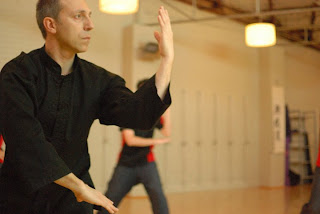
Occasionally folks who come to try out my taijiquan (t'ai chi ch'uan) class will "turn up their noses". "It's too complicated," they say in an accusing manner, as if I've deliberately tried to make them look stupid by giving them an impossible task or required an "anal" level of detail. They want to "flow" or "move their spirit" or "be one with their mind and body" or some other vague new-age concept. They identify taijiquan with such concepts and they expect to be "naturally good at it". Experts even. All without having tried it before. After all, they might have gone to some qi gong (breathing exercise) classes, meditation courses or something similar, where all they had to do was sit or stand, “breathe”, chant mantras and maybe do some basic macro body movements like swing their arms loosely. And that was all "natural". Or maybe they went to a yoga class where their genetic flexibilit...